
How Noam Chomsky’s 1950s insight became the blueprint for digitizing business friction in 2025.
For the last three years, we have been quietly answering a question that has stumped leadership teams for decades: Why do strategies fail?
The answer lies in a linguistic discovery from 70 years ago that most of the business world ignored.
The Two Layers of Intent
In the 1950s, Noam Chomsky revolutionized linguistics by proving that every sentence humans speak has two levels:
- Deep Structure: The raw, complete representation of the thought. The Truth.
- Example: “I made a mistake because I didn’t know what I was doing.”
- Surface Structure: The actual sentence that comes out of the mouth. The PR Version.
- Example: “Mistakes were made.”
In business, we generally accept that the difference between these two is just “politeness” or “diplomacy.”
The Work NLP Thesis is different.
We have isolated the source of the “Execution Gap.”
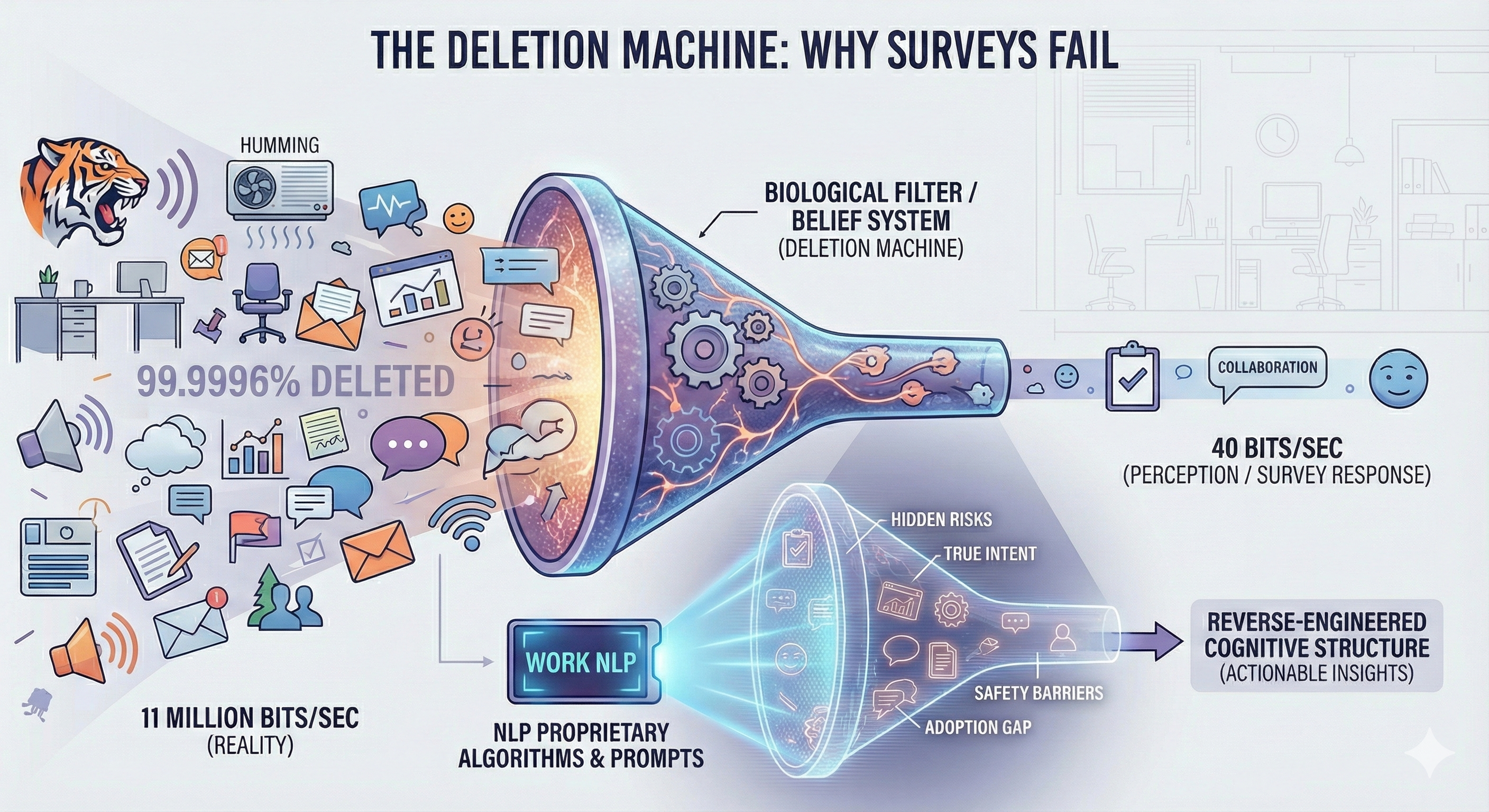
That invisible friction that kills deals and stalls integrations doesn’t happen in the boardroom. It happens precisely during the Transformation from Deep to Surface. When a leader feels fear, or a team feels resistant, they don’t just “lie.” They subconsciously apply a specific “Transformation Rule” to the syntax.
They delete the agent. They freeze the verb. They distort the timeline.
- Deep Structure (The Truth): “I am terrified to make this decision.”
- The Filter (Fear): Delete the ‘I’ $\rightarrow$ Add Universal Quantifier.
- Surface Structure (The Email): “Everyone agrees that we need more time.”
The friction isn’t in what they said. The friction is in what they deleted to get there.
Why We Ignore “Meaning”
I often get pushed back by rhetoric coaches and data scientists who say: “But context matters! You can’t understand the meaning without the context.”
They are right. You cannot measure Meaning without context.
But we aren’t measuring Meaning.
If you measure Meaning, you are asking: “When he said ‘Mistakes were made,’ did he mean to be deceptive, or was he just being polite?”
That is guesswork. That makes you a Literary Critic.
We measure Structure.
We ask: “Did the sentence contain a passive verb construction that deleted the biological agent?”
That is a binary fact. That makes you a Mathematician.
Meaning is subjective. Structure is forensic.
The Universal Resistance Grammar
Chomsky argued that humans possess a “Universal Grammar”—an innate set of rules for creating language.
Our data proves that humans also possess a “Universal Resistance Grammar.”
When the human brain encounters risk, it triggers specific neurological reflexes that show up in the syntax, regardless of culture, language, or “Context”:
- When we are Avoidant, we use Passive Voice (deleting the doer).
- When we are Scared, we use Nominalizations (turning verbs into nouns to freeze action).
- When we are Rigid, we use Universal Quantifiers (words like always, never, everyone).
These aren’t style choices. They are the fingerprints of friction.
For the first time, we aren’t guessing why adoption is low. We aren’t reading the room. We are using modern LLMs to audit these structural patterns at a scale and fidelity that simply wasn’t possible three years ago.
We are carrying the torch of Universal Grammar into the digital age. We don’t need to know your story. We just need to see your syntax.
The Red Tiles don’t lie.
DM me for a demo of our app.